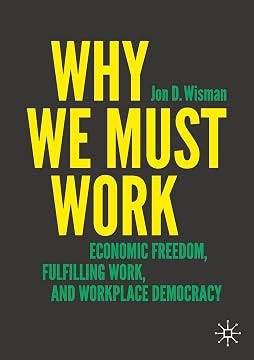
In this interview, Professor Jon Wisman discusses his book, Why We Must Work: Economic Freedom, Fulfilling Work, and Workplace Democracy. Wisman outlines the central premise of his work: human beings evolved to find work naturally fulfilling, pleasurable, and integrated with leisure, community, and social respect. However, the rise of elite-controlled states roughly 5,500 years ago debased work into an unpleasant means of survival under external command—a view perpetuated by mainstream economics, which treats work as “disutility”.
Wisman argues that despite reaching material abundance in rich nations, modern society faces widespread insecurity, stress, and dissatisfaction because it prioritizes consumption over fulfilling work. To restore work to a source of human thriving, he proposes two major structural reforms within a market framework: guaranteed employment (a job guarantee) and workplace democracy (worker ownership and democratic control). He emphasizes that an interdisciplinary approach—incorporating anthropology, history, and psychology—is essential to understanding these economic dynamics. Ultimately, he frames workplace democracy and reduced inequality not only as economic improvements, but as urgent political necessities to preserve democracy and avoid global ecological collapse.
Key Highlights
Evolutionary Perspective on Work vs. the Rise of Debased Work
For approximately 98% of human history, work was intrinsically pleasurable, social, and non-distinct from leisure. It became debased roughly 5,500 years ago when military and political elites seized control of productive resources (such as land) and subjected the population to forced labor, forcing work to become an unpleasant means to an end.
The Absurdity of Modern Scarcity Mindset
Despite rich nations solving the problem of material scarcity, workers still face high stress, insecurity, and alienating work conditions. Wisman stresses that additional consumption does not bring long-term happiness; true fulfillment comes from creative, community-oriented, and respected work.
Two Key Structural Proposals: Job Guarantee and Workplace Democracy
Guaranteed Work: Eliminates unemployment by positioning the government as a safety net to train and transition workers back into the market, which would eliminate poverty, reduce inequality, and force private employers to improve wages and working conditions.
Workplace Democracy: Transitions the economy toward worker-owned and democratically run firms where workers elect their coordinators/managers, eliminating arbitrary bosses and restoring intrinsic motivation.
Preserving Capitalism Without Exploitation
Wisman’s model retains core capitalist elements—private property and market competition driven by self-interest—but disperses property ownership democratically among workers rather than concentrating it in an elite class. This creates a market economy without systemic exploitation or extreme inequality.
Interdisciplinary Scope and Democratic Survival
Wisman criticizes mainstream economics for ignoring insights from anthropology, history, and psychology. He warns that failing to address extreme inequality threatens global democratic institutions. In turn, a loss of democracy impairs humanity’s collective ability to address pressing global issues, including climate change and ecological collapse.